
The ice trade in history
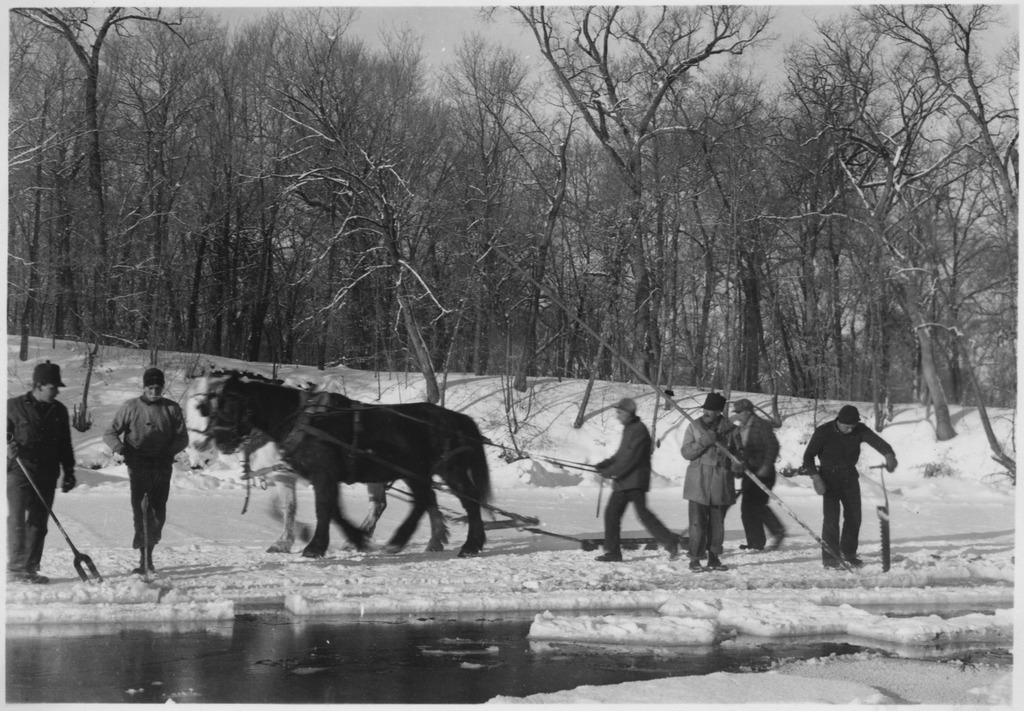
In the late nineteenth century the ice trade was a revolutionary business. Ice could not yet be manufactured, so it was cut from frozen ponds and streams. A network of ships, trains and ice wagons carried it onwards, sometimes as far as tropical islands. Ice kept meat, vegetables and fruit fresh for longer, and the fishing industry grew significantly on the back of it.
Norway alone exported some 910 million kg of ice every year. The trade collapsed after the invention of the refrigerator — in effect the heat pump — which removed the need to harvest ice from nature.
The ice trade was, in essence, trade in (cold) energy. Ice was simply a storage medium: a historical form of energy trading.
The energy in a phase transition
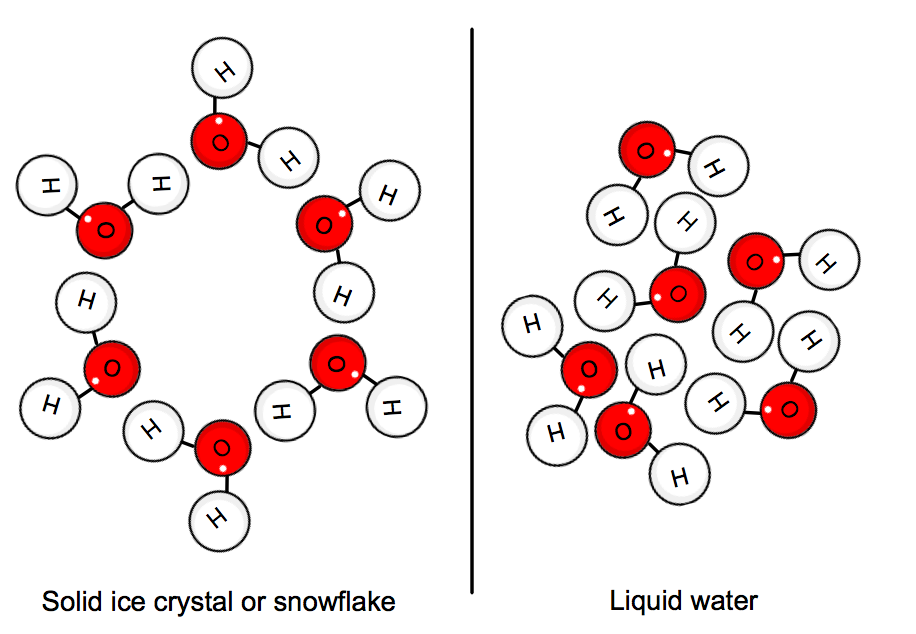
We experience the vibration and rotation of molecules as temperature: the more they vibrate, the warmer the object. In a solid phase such as ice those molecules vibrate less and are locked into a crystal structure. The crystal structure of ice is very strong, and a great deal of energy is needed to separate the molecules again (melting), after which the ice returns to water.
Phase transitions are energy-rich phenomena. They occur when a material cools or warms sufficiently, and they take place at a constant temperature — because the heat energy is not used to warm or cool the material, but to build a new ordering, a new structure. A crystal structure forming out of water as it freezes, for example. As soon as the energy (heat) overcomes the attraction between the water molecules, a phase transition takes place. That added energy increases the vibration and rotation of the molecules, which changes the phase from solid to liquid.
Energy of fusion
Materials that store energy in a phase transition are known as Phase Change Materials (PCMs). A PCM can be almost anything: salts, metals — and water too. The heat energy is stored in the phase transition and released again later.
Melting ice releases a great deal of energy. This phase transition has an enthalpy (dH) of +6.01 [kJ/mol]. Melting 1 [m3] of ice releases 83.5 [kWh] — the same amount of energy needed to heat one cubic metre of water from 0 to 75 degrees Celsius.
Heat capacity
The heat a material can hold is called its heat capacity. Ice stores 1847 [kJ/K] per cubic metre. Once it has melted, the water in the ice battery can absorb energy as well: the cooling installation no longer has to cool down from warm outside air, but from water temperature. Storage in the water itself amounts to 4186 [kJ/m3 K].

Thermal resistance
Ice has a high thermal resistance, which means it does not readily conduct heat. Thermal conductivity is a property of the material itself. The calculation for thermal resistance is shown below.
Because ice has a high thermal resistance, it is well suited to storing energy over medium-length periods.

The ice battery is based on a phase transition and is therefore fully reusable. After thawing, the same water is used to make ice again during the next freezing cycle. That makes it both safe and environmentally friendly.
Our ice battery discharges through conduction and convection. The cold of the ice is transferred by conduction to a polyethylene tube, with the working fluid flowing along the inside of it. Polyethylene is a robust but flexible plastic, known for being fully recyclable. The heat transfer between ice and polyethylene is described by Fourier’s law.

Polyethylene
Here [W/m2] is the flow of cold running from the ice into the polyethylene tube. The polyethylene in turn gives up cold to the working fluid used in your process — to cool air that cools your product, for example. This happens through forced convection, which Newton described in his law of cooling.

Comparing the ice battery
The energy in an ice battery can be compared with that of an electric battery, though the comparison is a skewed one.
Converting electrical energy into thermal energy is highly efficient: the sCOP is 3 to 4. That means 1 kWh of electricity is worth roughly 3 kWh of thermal output. This works against heat and cold batteries, because they store energy as heat and cold and therefore have to store three to four times more thermal energy for the equivalent electrical storage.
Against that stand considerable advantages: a cheap storage medium (water) and virtually no degradation of the battery. That is what makes this form of energy storage genuinely sustainable and affordable.
A lithium battery (Li-ion), by contrast, suffers badly from degradation. The problem lies in discharging and charging: chemical reactions such as oxidation (discharging) and reduction (charging) wear down the anode and cathode. That wear can eventually short-circuit the cell. Lithium is also highly reactive with water, and flammable. The ice battery has none of these problems.
Ask us about the possibilities for sustainable energy storage — get in touch with De Korne directly